
Amidst the glowing tributes for National Security Advisor Brajesh Mishra, who died last week, it must not be forgotten that he was pivotal to bringing about far-reaching but questionable shifts in India's security and foreign policy stances and forging a hard-line national security apparatus, says Praful Bidwai.

Manmohan Singh has accepted Mishra's resignation with effect from May 22, an official announcement said.

Vice President Hamid Ansari, Congress chief Sonia Gandhi, Union Minister Farooq Abdullah, National Security Advisor Shivshankar Menon, former External Affairs Minister Natwar Singh and BJP leaders Arun Jaitley and Ravi Shankar Prasad were among the prominent personalities who attended the cremation.

Noting that Pakistan had done nothing on the 26/11 case, former National Security Adviser Brajesh Mishra on Tuesday said the government had made a "serious mistake" by holding talks and these were "bound to fail".
Launching a sharp attack on Army Chief Gen V K Singh, former National Security Adviser Brajesh Mishra on Sunday said that he should be sent on "forced leave" and not sacked.

Brajesh Mishra, the country's first National Security Adviser who played a key role in foreign policy matters and pushed for deeper engagement with the United States, died in New Delhi on Friday evening following a heart ailment.
Dixit replaces Brajesh Mishra, who resigned on Tuesday.

Senior analyst B Raman assesses Brajesh Mishra's role as India's first National Security Advisor, his part in the 1998 nuclear tests, the Kargil conflict and more.
Former National Security Adviser Brajesha Mishra in the Bharatiya Janata Party-led National Democratic Alliance government has said both the BJP and Congress were indulging in "petty" electoral politics on terror attacks.
The Bharatiya Janata Party will never come back to power without a more inclusive agenda as Hindutva is not regarded as a positive force for Hindus, former National Security Adviser Brajesh Mishra said on Friday.
Despite the historic victory of Barack Obama in the Presidential elections and 'the change' he has promised, Unites State's foreign policy would continue to be guided by its national interest as it has been since World War II, feels former National Security Adviser Brajesh Mishra.Chairing a discussion on 'Indo-US Nuclear Deal: Impact on Asian Security Framework' at Observer Research Foundation, Mishra said the Bush administration had been working on two key US strategies.
Contradicting Bharatiya Janata Party's views on the nuclear deal with the United States, former National Security Adviser Brajesh Mishra has said India should go ahead with the agreement, failing which the country will have a 'severe loss of face' and suffer a setback to its atomic programme. Mishra said the deal should be concluded during the tenure of Bush administration as change of government in the US would make things difficult.
The luncheon meeting took place at the prime minister's official Race Course Road residence.
Former National Security Adviser Brajesh Mishra said on Thursday that senior Bharatiya Janata Party leader and former Union Home Minister L K Advani was aware of all the key decisions taken with regard to the hijacking of an Indian Airlines plane to Kandahar, Afghanistan.
'There is an understanding between the people of two countries that violence is not going to solve the Kashmir issue. A final understanding will take time,' says former national security adviser Brajesh Mishra.
The February 25 India-Pakistan talks are bound to fail. India is acting under American and British pressure. The Americans and the British are just looking for an honorable excuse to flee from Afghanistan. And Pakistan will continue to undermine India till the Indian armed forces don't have clear superiority. This, in essence, is what former Indian national adviser Brajesh Mishra -- a vocal opponent of New Delhi's latest olive branch to Islamabad -- feels.
India must re-negotiate its nuclear deal with the US in order to save its strategic interests, former national security adviser Brajesh Mishra said Tuesday night.

'If India does not succeed in making the US recognise the combined threat of the China-Pakistan alliance, there is nothing left in the visit,' says Brajesh Mishra, the former National Security Adviser.
'The priority at the moment should be to strengthen our internal security arrangements and improve coordination among the intelligence agencies, state governments and military authorities,' says Naresh Chandra, India's former ambassador to Washington.
The former US secretary of state, who is here to attend the two-day conference on 'Peace dividend: Progress for India and South Asia', said she has had an "abiding interest" in Kashmir for her entire life.
India's growing strategic partnership with the United States is never going to be easy as New Delhi might have to say 'no' to Washington on some occasions, former National Security Advisor Brajesh Mishra believes.

Former RA&W chief A S Dulat, who served as Atalji's adviser on Kashmir, gives us an insider's glimpse of a prime minister he has hailed as the 'greatest after Nehru'.

'They are both very individualistic and have similar personalities.'

In 2017, a retired R&AW officer conveyed that Uttar Pradesh Chief Minister Yogi Adityanath was keen to get monarchy restored in Nepal and suggested that I support these efforts.
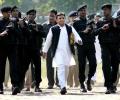
This is the first full-scale review of VIP protectees by the Union home ministry after the Modi 2.0 government took charge.

Ambitious diplomats continue to be attracted to politics but do they make good politicians, asks Jyoti Malhotra
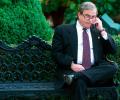
'In his eulogy at Sandy's memorial service, President Clinton recounted the unusually hot US Independence Day, July 4, 1999, when most of official Washington was more interested in watching fireworks than international diplomacy. Sandy insisted that Clinton confront Pakistan Prime Minister Nawaz Sharif in no uncertain terms.' Former US Assistant Secretary Raymond E Vickery, Jr salutes Sandy Berger, Clinton's National Security Adviser, as a true friend of India.
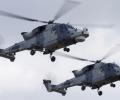
Nitin Gokhale, national security expert and founder BharatShakti.in, tells us what the controversy is all about.

'The Modi government's pusillanimity vis-a-vis Pakistan makes almost certain that India will, in the coming weeks and months, be confronted with cross border terrorist actions of increasing intensity,' warns Satish Chandra, former deputy national security adviser.
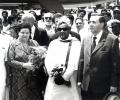
'I was present at a meeting where he decided to permit the IAF to strike at Pakistan positions in Kargil, with the caveat that they should not cross the LoC.' 'Confident that the Indian Army would succeed, Mr Vajpayee was positioning himself to tell the world after the Kargil conflict was won that India did not violate the 'sanctity' of the LoC,' recalls Ambassador G Parthasarathy, who served as India's envoy in Islamabad in that eventful year, 1999.
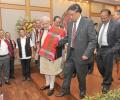
'He is still compulsively an operations man. Just a whiff of a live operation, and he is back in the field, at least in his mind. That is why the immediate decision to send the NSG to Pathankot.' 'But there is a difference between classical intelligence or counter-terror operation and dealing with a larger threat to a place as sensitive and sprawling as an air force base. This is what led to confusion and mix-ups,' says Shekhar Gupta.

With an aggressive Opposition and unyielding government, important legislation could be the biggest casualty, as details of the helicopter contract surface.

'Dulat's professional successors in the game would now find it that much harder to access/create meaningful sources/assets needed for effective functioning in a place like Kashmir. By blowing their cover the former top spy has undone whatever he might have been able to add to his organisation's resource kitty.'
